

 Aston Watson

B2B vs B2C reviews: the main difference
B2B vs B2C reviews differ in who reads them and what they need. A B2B review is read by a small buying group comparing vendors on G2 or Capterra, so it must show role, company size and fit. A B2C review is read by one person on Trustpilot or an app store, who checks ease, price and support.
Everything else follows from that split. A B2B buyer reads reviews to defend a choice to colleagues, so detail and relevance count more than the headline rating. A B2C buyer reads reviews to avoid a bad sign-up, so the star rating, the latest comments and how the company handles complaints count more than depth.
Many SaaS products sit in between. A design tool or a project tracker might be bought by a freelancer one day and a growing team the next, so it often needs reviews on both kinds of site.
Who reads the reviews: a buying group or one person
In B2B SaaS, a review has several readers. G2's Buyer Behavior in 2025 research, a survey of 1,169 B2B decision makers in April 2025, found that buying committees of 5 to 8 members are shrinking and smaller groups of 3 to 4 members are rising in software decisions. Department leads, IT and end-user champions all have a say, and each of them reads reviews for a different reason.
The same research found that nearly two out of three buyers now prefer to talk to vendor salespeople only in the later stages of their buying journey, up 17 points on the year before. That means the group does most of its checking alone, and reviews do much of the selling before your team joins the conversation.
In B2C SaaS, the reader is usually one person deciding for themselves. They can sign up in minutes, so they read fewer reviews and decide faster. One bad recent review about billing or a slow support reply can be enough to send them to a competitor.
Review platforms for B2C SaaS and B2B SaaS
Each model has its own set of sites, and it helps to know which ones your buyers check before you ask for a single review. B2B buyers use software review sites built for comparing vendors in a category, while the main review platforms for B2C SaaS are general sites such as Trustpilot and, for mobile products, the app stores.
| Buyer | Sites they read | What the site is built for |
|---|---|---|
| B2B SaaS buying group | G2, Capterra, TrustRadius, SourceForge, SoftwareSuggest | Comparing vendors in a category, filtered by company size and use |
| B2C SaaS buyer | Trustpilot, app stores | Checking a brand's rating and recent experiences before a sign-up |
| Prosumers and small teams | G2 and Trustpilot | Both: comparing tools and checking the brand |
On the B2B side, the sites are designed around comparison. A product sits in a category next to its rivals, and readers can narrow reviews to companies like theirs. Teams that want a faster start on these sites sometimes buy B2B reviews through a managed campaign, for example to purchase G2 reviews from verified users who write in their own words and choose their own rating. Founders who ask can you buy Capterra reviews should know that those campaigns run with the client's customers through Capterra's review link. Our guide to software review sites covers each B2B site in more detail.
On the B2C side, Trustpilot is the main general review site that software brands use. Consumer-facing products can buy real Trustpilot reviews through a campaign with verified users, which follows Trustpilot's rules on fair invitations. Mobile apps also collect ratings in the app stores, which sit right next to the download button.

How B2B buyers read reviews
How B2B buyers read reviews comes down to one question: is this reviewer like us? A five-star review from a solo freelancer tells a 300-person company very little, so B2B readers look for the reviewer's role, industry and company size before they read the text. G2's Research Scoring Methodologies build this into the site, with separate Grids for Small Business (50 or fewer employees), Mid-Market (51 to 1,000) and Enterprise (1,001 or more) that only count reviews from reviewers at companies of that size.
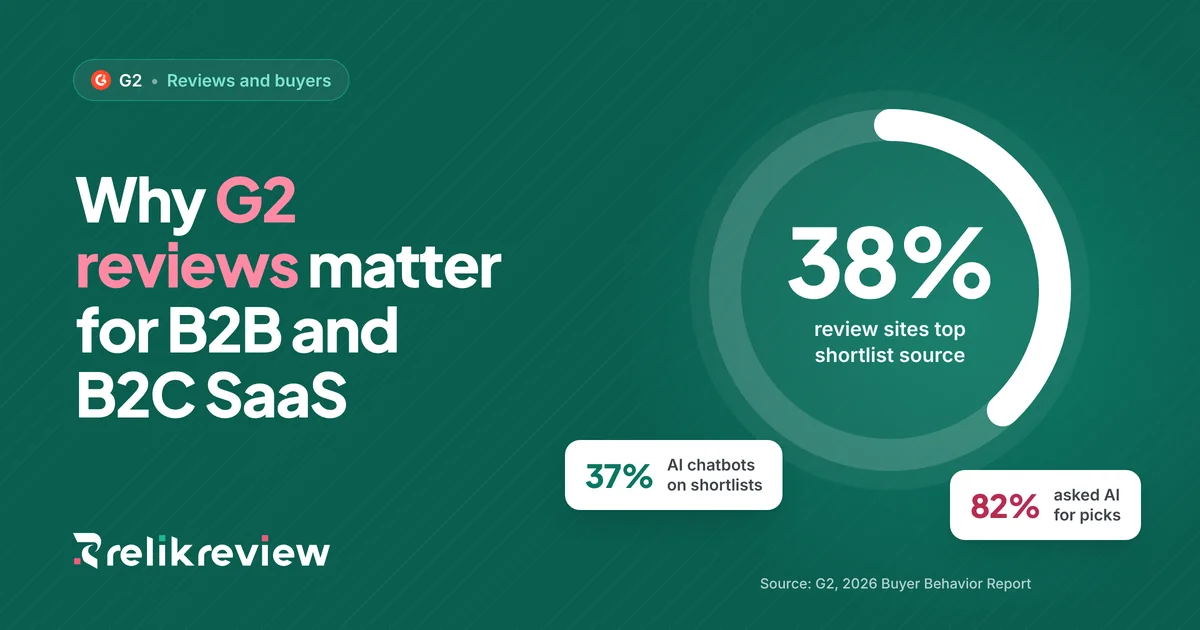
Reviews matter at every step of the group's work. In G2's 2026 Buyer Behavior Report announcement, published on 22 July 2026 and based on more than 1,000 B2B software buyers, review sites (38%) were the top source shaping which vendors make a shortlist, ahead of AI chatbots (37%). The TrustRadius 2026 B2B Buying Disconnect report, based on 1,862 technology buyers, found that 74% of buyers use reviews to inform their purchase decisions and 83% shortlisted 3 or fewer products.
With so few products on a shortlist, each B2B reader is checking a handful of specific things:
- Fit. Reviews from people in a similar role, industry and company size.
- Integrations. Whether the product works with the tools the team already uses.
- Onboarding and support. How long setup took and how the vendor responded when something broke.
- Security and admin. Details that help IT and finance sign off, since G2 found finance involvement in software decisions jumped from 31% to 46% in a year.

B2B readers also pay attention to how the vendor replies to critical reviews, since that is a preview of the support they will get. Our post on why G2 reviews matter shows how these reviews feed G2's Grid, badges and buyer intent data.
How B2C buyers read reviews
How B2C buyers read reviews is quicker and more emotional. A consumer looks at the overall star rating, scans the most recent reviews and checks whether complaints get a reply. They care about whether the product is easy to use, whether the price is fair and whether billing and cancellation are simple.
Consumer habits show how much weight they put on the rating and on recent reviews. BrightLocal's 2026 Local Consumer Review Survey, which tracks how consumers use reviews when choosing businesses, found that 41% of consumers "always" read reviews when browsing, up from 29% the year before. It also found that 68% will only use a business with four or more stars, up from 55% in 2025.
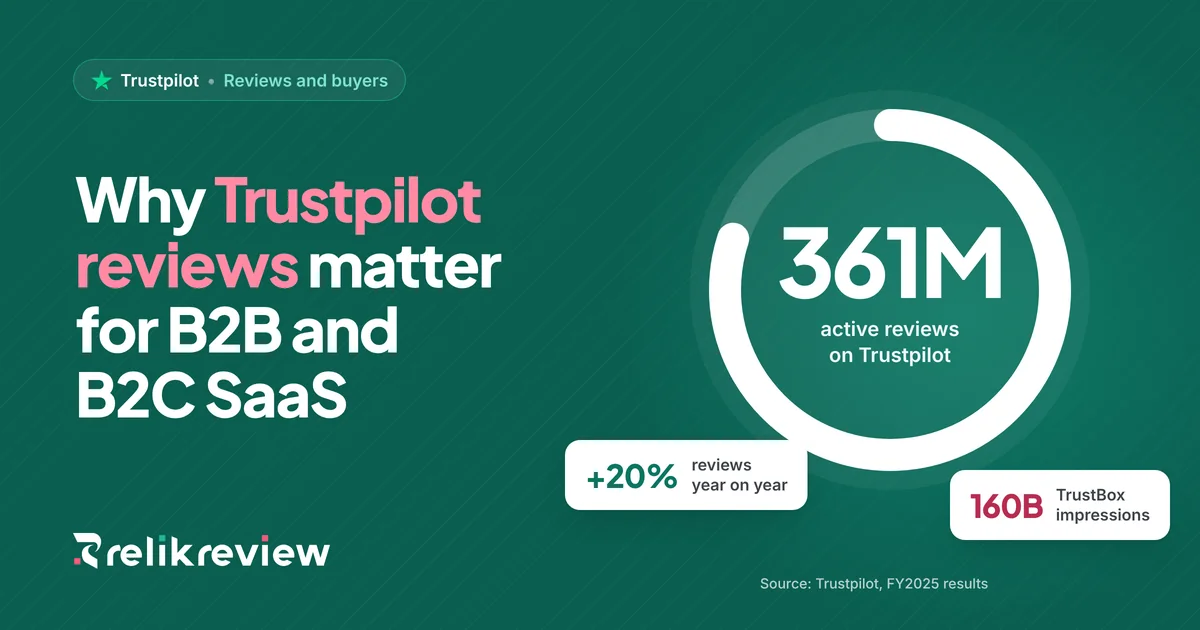
B2C readers also compare across many sites. The same survey found that the average consumer uses six different review sites when choosing businesses, so a strong rating on one site can be undercut by a weak one elsewhere. For a SaaS brand sold to consumers, a steady Trustpilot profile is usually the first one to fix, and our post on why Trustpilot reviews matter explains how buyers use it.

Review length, volume and recency in each model
B2B reviews tend to be longer and more detailed than B2C reviews, because the reader needs more to go on. A useful B2B review explains the use case, the team size, the setup and the trade-offs, and buyers often copy lines from it into an internal comparison. A useful B2C review can be a few sentences, as long as it is specific and recent.
Volume works differently too. In a niche B2B category with few rivals, a modest number of detailed, recent reviews can stand out, while a consumer product is judged next to apps that show far larger review counts. On G2, for example, a product needs at least 10 reviews in a category to appear on its Grid at all.
Recency matters in both models. G2's scoring weights recent reviews more heavily, and after about three years a review keeps roughly 3% of its original weight. On the consumer side, BrightLocal found that 74% of consumers seek reviews written in the last three months, so a profile with no new reviews this quarter looks stale to both kinds of reader.
B2B vs B2C reviews compared side by side
The table below sums up the differences, so you can see where your product sits and plan your review work around the right buyer. If you sell to both, treat each row as two separate goals.
| Factor | B2B SaaS reviews | B2C SaaS reviews |
|---|---|---|
| Who reads them | A buying group of 3 to 4 people | One person deciding alone |
| Main sites | G2, Capterra, TrustRadius, SourceForge, SoftwareSuggest | Trustpilot, app stores |
| What readers look for | Role, company size, integrations, support, security | Ease of use, price, billing, support |
| Length and detail | Longer, with use cases and trade-offs | Shorter, specific and recent |
| Volume needed | Fewer, detailed reviews from the right companies | More reviews to match rival apps |
| Recency | Recent reviews carry more weight on G2 | Most readers want reviews from the last three months |
| Who asks | Customer success managers, per account | Automated email or in-app message |
A B2B team that ignores these differences can end up with a Trustpilot profile nobody in its market reads. A B2C team can make the opposite mistake and build a G2 profile while its Trustpilot rating slides.
How to ask for reviews in each model
The rules for asking are the same in both models: ask every customer the same way, at a fixed point they all reach, and never tie a reward to the rating. Trustpilot's guidelines for businesses require businesses to invite everyone in the same way and at the same point in the customer journey, and they ban incentives such as discounts, promo codes and prize draws.
In B2B SaaS, one account has several users, and the person who signed the contract is rarely the heaviest user. Have customer success managers ask the main contact and the daily users at fixed points, such as day 90 and the account anniversary, and send each one a direct link to the right site. Spreading requests across G2 and Capterra keeps both profiles growing at a steady pace.
In B2C SaaS, volume makes manual asking impossible, so the request is automated. Send a short email or in-app message to every user at the same point, such as 30 days after sign-up or when a plan ends, with one link and no request for a particular rating. One reminder a week later is enough.
Want to see how we keep campaigns within each site's rules?
Read the RelikReview review policy for how reviewers take part and what we never promise.
Reviews for B2B and B2C SaaS with RelikReview
RelikReview plans review campaigns for both kinds of buyer, on the sites each one reads. See all our review services for G2, Trustpilot, Capterra, SourceForge, SoftwareSuggest and HubSpot, with the plan and price in writing first.
- Right site, right buyerB2B campaigns on software review sites, B2C on Trustpilot.
- Reviewers choose their ratingWe never promise ratings, badges or rankings.
- Steady pacingNew reviews arrive each month, with no sudden spikes.
B2B vs B2C reviews: where to start
The gap between B2B vs B2C reviews comes down to the reader. A B2B buying group wants detailed, recent reviews from people like them on the sites built for comparing software, while a B2C buyer wants a strong star rating and recent, honest comments on Trustpilot or an app store.
Start by listing where your buyers read reviews, then ask every customer at fixed points through those sites. If you would rather hand that work to people who run it every day, the RelikReview team can plan a campaign around your buyers.
FAQs about B2B and B2C reviews
Are B2B reviews different from B2C reviews?
Yes, B2B reviews differ from B2C reviews in their readers and their detail. B2B reviews are read by a small buying group comparing vendors, so they need role, company size and integration detail. B2C reviews are read by one person deciding alone, who mainly checks the star rating, the price and the latest comments.
Which review sites matter most for B2B SaaS?
The review sites that matter most for B2B SaaS are the ones built for comparing software, such as G2, Capterra, TrustRadius, SourceForge and SoftwareSuggest. Check which sites rank when you search your category with the word "reviews", and which ones your competitors use, then focus on the two or three your buyers read.
Is Trustpilot useful for B2B SaaS?
Yes, Trustpilot can be useful for B2B SaaS that sells to small teams, freelancers or prosumers, since those buyers check the brand as well as the product. For software sold to larger companies, G2 and Capterra usually come first, and Trustpilot works best as a second profile that shows how the company treats customers.
How many reviews does a SaaS product need?
The number of reviews a SaaS product needs depends on the model and the rivals. A B2B product needs at least 10 reviews in a category to appear on a G2 Grid, and detail matters more than volume after that. A consumer product usually needs more, because buyers compare its count with rival apps.
How recent should SaaS reviews be?
SaaS reviews should be as recent as possible, with new ones arriving every month. In BrightLocal's 2026 survey, 74% of consumers sought reviews written in the last three months, and G2's scoring gives older reviews less weight over time. A steady flow keeps both B2B and B2C profiles looking current.