

 Aston Watson

Software review sites: what they are and which ones matter
Software review sites are platforms where checked users rate and describe the software they use, so buyers can compare products before they speak to sales. For B2B SaaS, the ones that matter most are G2, Capterra with GetApp and Software Advice, TrustRadius, Gartner Peer Insights, SourceForge, SoftwareSuggest, the HubSpot App Marketplace and Trustpilot.
They differ more than their star ratings suggest. Some serve a business team browsing a category, some an IT team checking a shortlisted vendor in depth, and some one ecosystem or one type of buyer, so the sections below follow a buying team from shortlist to sign-off.
RelikReview runs SaaS review services on six of these sites and helps teams decide where to start. Teams that want to get G2 reviews or purchase SourceForge reviews work with verified users, while campaigns for teams buying Capterra reviews run with their own customers through Capterra's review link.
How buyers use review sites at each decision stage
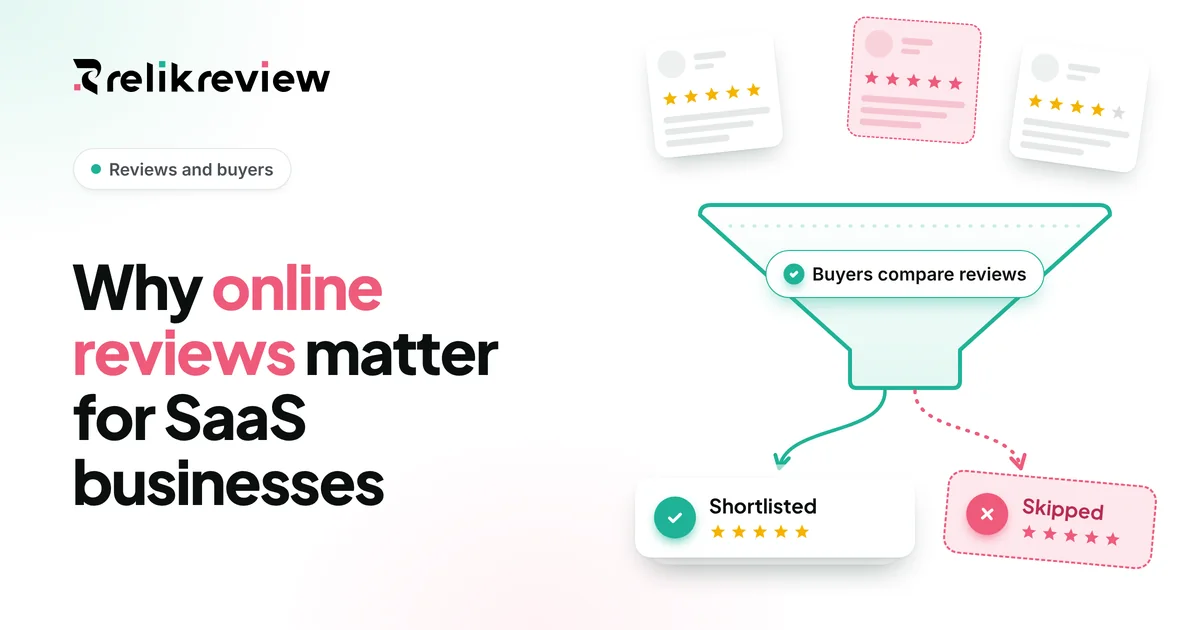
B2B buyers check review sites more than once during a purchase. In G2's 2026 Buyer Behavior Report, a survey of more than 1,000 B2B software buyers and decision-makers published on 22 July 2026, review sites were the top source shaping which vendors make a shortlist, at 38%, with AI chatbots close behind at 37%. G2 runs a review site itself, so read the figures as one publisher's research.
The same report shows how many people a deal has to satisfy after the shortlist. Finance involvement in software decisions rose from 31% to 46% in one year, and IT security review was the top source of delay, cited by 39% of buyers overall and 50% of enterprise buyers. Each of those people may open a different site to check the same vendor.

Early in a purchase, buyers browse category pages and compare scores, so a profile with plenty of recent reviews matters most. Later, security, finance and IT reviewers want detail from people in roles like theirs, and our guide to the question why are online reviews important explains how that social proof builds trust before a buyer talks to sales.
SaaS review sites buyers use to build a shortlist
Two names cover most of the shortlist stage for B2B software: G2 and the Capterra network. Since early 2026 they have shared an owner, but each still runs under its own name with its own reviewers and its own rules.
G2
G2 describes itself as the world's largest and most trusted data source for B2B software and says its ecosystem serves more than 200 million annual buyers. Its readers are people choosing software for a team or a whole company.
Under G2's community guidelines, reviewers sign in with LinkedIn, a verified business email or a personal email so G2 can confirm who they are, and the experience must fall within the past two years. Automated filters run first, then G2's team checks each review by hand before it goes live. Any vendor can claim a G2 profile for free, and G2 says its research team verifies a new listing in about 3 to 5 business days, after which review counts, page views and leads show in the vendor's my.G2 account.
Capterra, GetApp and Software Advice
G2 announced on 29 January 2026 that it had agreed to buy Capterra, Software Advice and GetApp from Gartner, and by June 2026 it called the three sites G2 Digital Markets. Capterra and GetApp serve business buyers comparing tools in a category, while Software Advice offers free one-on-one advisors who send a buyer a tailored list of options, which it says arrives within 15 minutes.
Capterra's community guidelines, last updated on 4 May 2026, require a verified identity for every reviewer and allow a review to appear on Capterra, GetApp, Software Advice and partner sites. Capterra says more than 30 human moderators and more than 20 control checks stand behind its reviews, and reviewers who look suspicious must show proof of use. Its free Launch tier gives vendors a profile listing, Vendor Portal access and turnkey review collection.
B2B review sites for enterprise and IT evaluation
Once a vendor makes the shortlist, security, IT and procurement teams want long reviews from people in similar roles. Two B2B review sites are built around that reader.
TrustRadius
TrustRadius says its free vendor profiles put a product in front of more than 1 million monthly buyers, whom it describes as B2B tech buyers doing research. Every reviewer signs in with LinkedIn or a work email, a member of its research team reads each review and confirms recent experience, and about 3% of reviews are rejected. The average review runs 400 words and takes 18 minutes to write.
Labels such as "Invited by: Vendor" and "Incentive: Yes" show where each review came from, and the trScore favors recent, in-depth reviews from representative samples of customers. A claimed profile costs nothing and lets a vendor add the pricing, integrations, demos and security details evaluation teams look for.
Gartner Peer Insights
Gartner describes Peer Insights as a verified peer-driven review platform serving buyers and sellers of enterprise technology and business solutions. Reviewers must be IT or business professionals or technology decision makers with a corporate email that matches their stated company, and they do not need to be Gartner clients. Average ratings give full weight to reviews from the last 12 months, half weight at 12 to 24 months and a quarter at 24 to 36 months.
Vendors can create review sourcing links and reply to reviews, and Gartner's FAQ for technology providers says they are free to encourage customers to write reviews. New vendors also get 50 Gartner-funded $25 gift cards to use in their first six months, and any incentive must be offered equally for all reviews, never only for positive ones.
Planning reviews for more than one buying stage?
See how our review campaigns work, from the written plan to the last review on each site.
Review sites for developers, smaller businesses and app ecosystems
Some buyers skip the large category sites altogether. Developers, small and mid-sized businesses and teams adding apps to a platform they already use each have a site of their own.
SourceForge
SourceForge calls itself the complete software platform for software discovery, reviews, comparisons and downloads, with over 20 million visitors per month and over 127,100 software titles. B2B and IT professionals use it to find business software, and developers use it to build, download and publish open source projects, so it suits developer, IT and security tools.
SourceForge's review guidelines say its team examines every review before publication and asks reviewers for a business email, with extra checks such as LinkedIn or phone verification when one is missing. Claiming, editing and managing a listing is free, and the review generation services start on the paid Plus plan.
SoftwareSuggest
SoftwareSuggest helps businesses find software and service partners, with over 50k software and services listed and over 40,000 verified reviews. Its pages name startups, SMBs and mid-market companies among the businesses it serves, so it reaches small and mid-sized business buyers, who can also ask for free, personalized software recommendations.
Under SoftwareSuggest's review guidelines, reviewers confirm their identity through LinkedIn or a verified business email, pass a conflict-of-interest check and a five-step moderation checklist, and must have used the software within the past two years. Vendors can register a listing for free and reply to reviews through the Vendors Portal, but only users may submit reviews, and review links must be shared through private channels.
HubSpot App Marketplace
For apps that plug into HubSpot, the marketplace listing is where customers judge an app before they install it. Only logged-in HubSpot users who have the app installed, or removed it less than 14 days ago, can leave a review, and only the first three users in an account may review the same listing.
HubSpot also does part of the asking for free. It sends a review request to each user 30 days after install, and partners can copy a review link from the listing's Customer Feedback tab. A listing needs at least 10 reviews before it shows a star rating, and HubSpot's reviews policy bars partners from offering any compensation for a review.
Trustpilot for software that individuals choose
Trustpilot works differently from every site above, because it covers businesses of every kind. It calls itself the world's largest open feedback platform, where anyone can share what happened, good or bad, and its guidelines let anyone over 18 with a recent, genuine experience review a business.
That makes it a strong fit for consumer and prosumer apps, where one person signs up and pays with a card. Businesses must invite everyone in the same way at the same point in the customer journey, may not offer incentives of any kind, and can send 50 automated invitations a month on the Free plan. Our comparison of b2b vs b2c reviews explains why these two kinds of buyer read reviews so differently.
What vendors can set up for free first
Most sites in this guide let a vendor start without paying, so the first job is setup. A claimed profile with accurate pricing, features and screenshots gives buyers a reason to trust the reviews that follow.

Once a profile is live, ask every customer the same way at a fixed point they all reach, such as day 30, day 90 or the account anniversary. G2, Capterra, Gartner and Trustpilot all ban requests aimed only at happy customers, and replying to reviews, good and bad, shows buyers that someone is listening. Our guide to online reputation management for saas covers how to keep that work going across several profiles.
How to choose the best software review sites for your product
The best software review sites for a product are the ones its buyers already open, so the choice starts with the buyer. Three questions settle it for most SaaS companies: who approves the purchase, what kind of product it is and which stage of the decision needs the most help.
By audience
If one person signs up and pays with a card, Trustpilot covers most of their research. If a team or a finance lead approves the purchase, G2 and Capterra come first, and if IT security has to sign off, TrustRadius or Gartner Peer Insights should follow.
By product type
The product itself narrows the list further. Use this table as a starting point, then check where your closest competitors already have reviews:
| Product type | Start with | Add next |
|---|---|---|
| Business software sold to teams | G2, Capterra | TrustRadius |
| Enterprise or security software | G2, Gartner Peer Insights | TrustRadius |
| Developer, IT or open source tool | SourceForge | G2 |
| HubSpot app or integration | HubSpot App Marketplace | G2 |
| Software for small and mid-sized businesses | Capterra, SoftwareSuggest | G2 |
| Consumer or prosumer app | Trustpilot | G2 |
By decision stage
If prospects drop away before they ever ask for a demo, the gap is usually at the shortlist stage, so G2 and Capterra profiles come first. If deals stall in security or procurement review, detailed reviews on TrustRadius or Peer Insights give those teams the evidence they ask for.

Start with one or two sites and build each one up before adding more. A profile that gains a few reviews every month tells a buyer more than several that went quiet a year ago.
Start on the right review sites with RelikReview
RelikReview runs review campaigns on G2, Trustpilot, Capterra, SourceForge, SoftwareSuggest and HubSpot, and helps you pick where to start. See our SaaS review services for each platform, with the plan and price in writing first.
- Verified users where allowedG2, Trustpilot, SourceForge and SoftwareSuggest campaigns use verified users.
- Your customers on Capterra and HubSpotEach campaign uses the platform's own review link.
- Never paid, own ratingEvery reviewer chooses their own star rating.
Where to start with review sites
Software review sites each serve a different reader: G2 and the Capterra network for shortlists, TrustRadius and Gartner Peer Insights for evaluation, and SourceForge, SoftwareSuggest, HubSpot and Trustpilot for specific buyers and products. Pick the one or two your buyers open first, claim the free profile and ask every customer the same way.
Add the next site once the first one has a steady pace of new reviews. If you would rather hand that work to a team that runs it every day, the RelikReview team can help you buy reviews online within each platform's rules, starting with a written plan.
FAQs about review sites for SaaS
Which software review site should a SaaS company start with?
A SaaS company should start with the software review site its buyers open first. For products sold to business teams that is usually G2 or Capterra, for developer tools SourceForge, for HubSpot apps the HubSpot App Marketplace and for consumer apps Trustpilot. Claim the free profile there, then ask every customer the same way.
Are reviews on SaaS review sites verified?
Yes, the main sites check reviewers before they publish a review. G2, TrustRadius and SoftwareSuggest confirm identity through LinkedIn or an email address, Gartner Peer Insights matches a corporate email to the stated company, and Capterra asks suspicious reviewers for proof of use. Most also bar employees of the vendor and its competitors.
Are Capterra, GetApp and Software Advice the same company?
Yes, Capterra, GetApp and Software Advice share an owner, and that owner is now G2. G2 announced the deal with Gartner on 29 January 2026 and calls the three sites G2 Digital Markets. A review collected through Capterra may also appear on GetApp, Software Advice and partner sites.
Is it free to list software on review sites?
Yes, most review sites let vendors list software for free. G2 lets vendors claim a profile at no cost, Capterra has a free Launch tier, TrustRadius and SourceForge offer free profiles, and SoftwareSuggest lets vendors register for free. Trustpilot's Free plan includes 50 automated invitations a month, and paid plans add visibility and lead tools.
Which review sites matter for enterprise software?
Enterprise software buyers lean on review sites that check each reviewer's work identity and publish detailed reviews. Gartner Peer Insights serves buyers and sellers of enterprise technology, and TrustRadius reviews average 400 words from reviewers checked through LinkedIn or a work email. Pair one of them with a G2 profile to cover the shortlist stage too.
Do review sites allow incentives for reviews?
Some review sites allow incentives for reviews and others ban them. G2 allows them up to $100 when they never depend on the rating, Capterra and Gartner require them to be offered equally to every reviewer, and SourceForge allows them only through its Incentive Program. Trustpilot and HubSpot ban incentives for reviews completely.