

 Hazel Ryan

How the G2 Grid works: the short answer
G2 scores every qualifying product in a category on two things: customer satisfaction, taken from its reviews, and market presence, taken from reviews plus outside data about the vendor. Both scores are normalized from 0 to 100 across the category, and the product is plotted where the two meet, which places it in one of four quadrants.
G2's Research Scoring Methodologies, last updated on 26 August 2026, say the rank depends on both raw scores and how scores are spread across the category. That means your position is always relative: if competitors collect more recent reviews than you, your dot can move even when nothing changed on your side.
Placement is also automatic. G2's note on why Grid placement cannot be changed manually says placement is determined algorithmically and that no one, including G2 employees, can change a product's position by hand. The same page names the most effective way to improve placement as collecting more recent reviews from verified users, which is the work our G2 review service supports, while RelikReview review services cover the other sites your buyers read.
The two scores: G2 satisfaction score and G2 market presence
The vertical axis is satisfaction. G2's badge guide describes it as derived from actual user reviews, looking at ratings, the quality of reviews and their recency. In plain terms, it answers one question for a buyer: do the people who use this product like it?
The horizontal axis is market presence. G2 describes it as based on market share, seller size and social impact, measured through review counts and data from outside sources such as ZoomInfo, LinkedIn, Crunchbase, Moz and Similarweb. It answers a different question: how big and visible is this product in its category?
The four quadrants on G2's Grid
Once both scores are plotted, the chart splits into four quadrants. G2's guide to understanding its badges places Leaders in the top right quadrant, with high satisfaction and high presence, and High Performers in the top left, with high satisfaction and lower presence.

The lower half holds the other two. In a G2 support answer on Grid quadrants, a G2 support manager describes Contender products as having relatively low customer satisfaction scores and high market presence, and Niche products as having relatively low satisfaction scores and low market presence, both compared to the rest of the category.
| Quadrant | Satisfaction | Market presence | Where it sits |
|---|---|---|---|
| Leader | High | High | Top right |
| High Performer | High | Lower | Top left |
| Contender | Relatively low | High | Bottom right |
| Niche | Relatively low | Low | Bottom left |
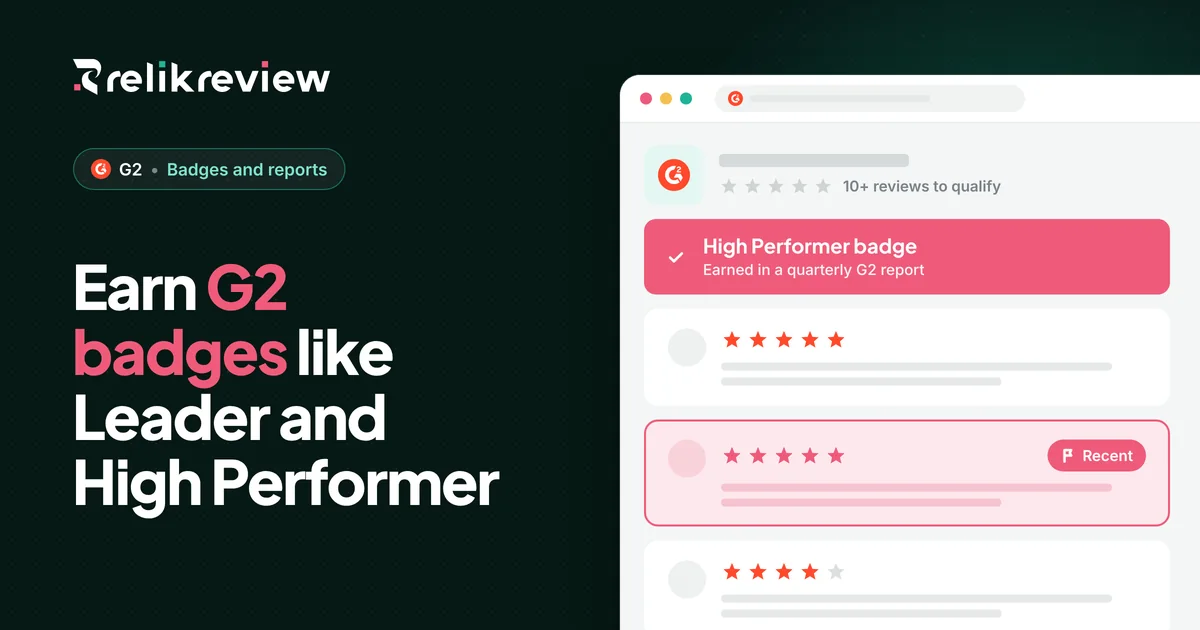
The quadrant matters beyond the chart. G2's badge guide says its Leader and High Performer awards are given based on placement on the Grid, while the Contender and Niche quadrants generally do not receive badges. Our guide to g2 badges covers how each badge is earned and how to use it in sales material.
What goes into the satisfaction score
G2 builds satisfaction from the answers reviewers give in the review form, then adjusts those answers for how much each review should count. The methodology page gives every input an importance level of High, Medium or Low.

The review answers fall into three groups:
- User-focused scores (High): Ease of Use, Meets Requirements and Quality of Support.
- Admin-focused scores (Medium): Ease of Admin, Ease of Setup and Ease of Doing Business With.
- General satisfaction (Low): Likelihood to Recommend and Direction of Product.
The weighting then rests on four review traits. Review volume is High, because G2 weights response data by the total number of reviews to assess popularity and statistical significance. Review recency is also High, because recent reviews are more relevant to buyers and older ones are weighted less. Review quality is Medium, since more thoroughly completed reviews count for more, and review source is Low, giving extra weight to current users and people with more experience of the product.
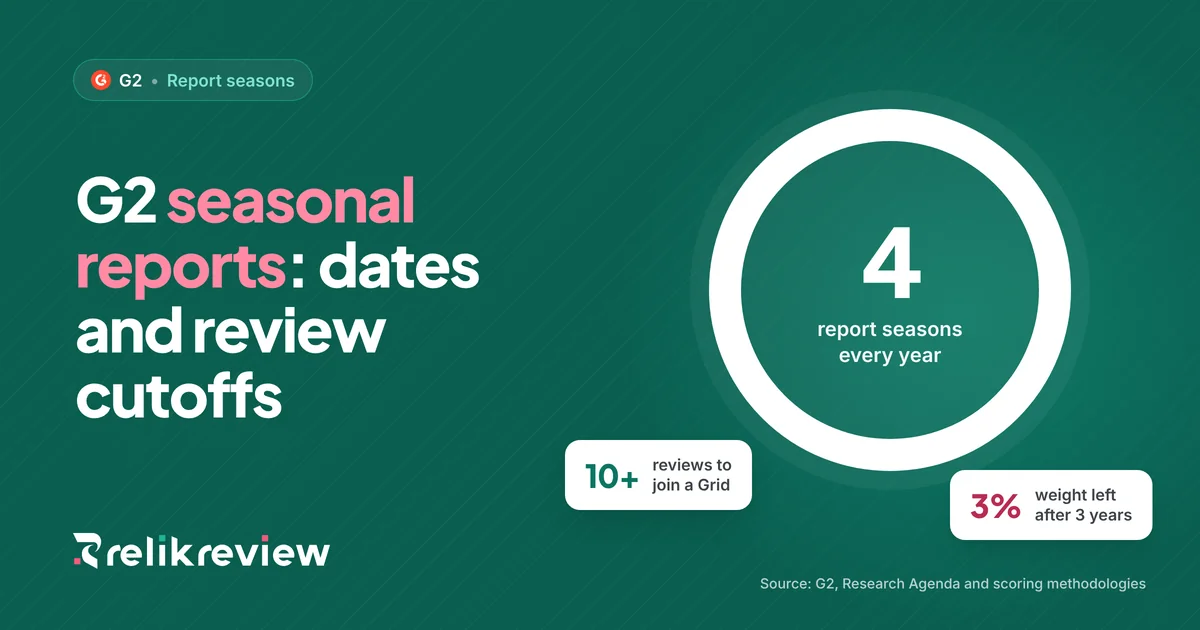
Recency affects every review you already have. Under G2's review decay rules, a review decays gradually for the first 90 days and keeps a stronger weight for the first 18 months, and after about three years it reaches approximately 3% of its original weight. G2 also resets the decay when a reviewer updates an existing review. Every review still has to pass G2's moderation first, which our post on g2 review guidelines explains.
What goes into the market presence score
Market presence uses more outside data than satisfaction does. The inputs G2 rates as High importance are the weighted review count in the category and the vendor's employee count on ZoomInfo and on LinkedIn. Medium inputs are employees on Crunchbase, revenue on ZoomInfo, Moz Product Page Authority and estimated search volume.
The Low inputs are product page traffic, Moz Vendor Domain Authority, several Similarweb measures (total visits, PPC spend, new visitors and organic search traffic), Crunchbase Rank, vendor employee growth and year founded. G2 refreshes these on different schedules: Crunchbase, employee share and G2 review counts and ratings daily, STAT Search Analytics weekly, and Similarweb, LinkedIn, Moz and ZoomInfo monthly.
For most SaaS teams, the honest reading is that presence is hard to move quickly. Headcount, revenue and domain authority grow with the business, so the input you can affect month to month is the weighted review count, which rewards the same recent, complete reviews that lift satisfaction.
Minimum reviews to appear on the G2 Grid
A product has to reach a review floor before G2 places it at all. The methodology page sets two thresholds, one for the live chart on category pages and one for the seasonal reports.

For live Grids, G2 shows them on category pages that have at least three products with 10+ reviews. For a seasonal report, a category must have at least six products with 10+ reviews and 150+ reviews overall, and a product must have at least 10 reviews in that category to qualify for inclusion.
The phrase "in that category" matters. Reviews are counted per category, so a product listed in two categories needs 10 reviews attributed to each one before it appears on both charts. If you sell into a new or narrow category, the category itself may not meet the six product and 150 review bar, and no seasonal report is published for it until it does.
How often the Grid updates, from live Grids to the G2 Grid report
There are two versions of the chart, and they move at different speeds. G2 says placement on live Grids is updated daily, so a buyer browsing a category page sees a position that reflects reviews and data from the last day or so.
The G2 Grid report is the fixed, seasonal version. G2's badge guide says awards are calculated every quarter, in Winter, Spring, Summer and Fall, and the methodology page sends vendors to G2's Research Agenda for the key dates of each upcoming report. G2 also shows draft reports in the Report Library approximately two weeks before each release, which gives vendors a preview before the report goes public. Our guide to g2 seasonal reports covers the report dates, cutoffs and how to plan for them.
Other Grids in each report
G2 also publishes narrower versions of the same chart. Segment Grids only include reviews from reviewers employed by a company in one segment: Small Business (50 or fewer employees), Mid-Market (51 to 1,000 employees) and Enterprise (1,001+ employees). The Momentum Grid adjusts the market presence model to favor products with large year-over-year changes.
How new reviews move a product on the Grid
Because satisfaction is built from reviews, a steady flow of recent reviews is the most direct way to move on the Grid. Each new review adds to your review volume, carries full recency weight and adds to the weighted review count inside market presence, while older reviews keep losing weight in the background.
That decay is why a burst of reviews followed by silence tends to fade. Reviews collected in one push keep a stronger weight for about 18 months, then slide toward a small fraction of their value, so a product that stops collecting can drift down even if its customers are just as happy. A product that adds reviews every month keeps its satisfaction data fresh and its weighted count growing.
The practical plan is a fixed rhythm that reaches every customer, whatever their experience:
- Ask every customer at the same points, such as day 90 and each account anniversary, so the sample is fair.
- Ask for complete answers to the review form, since fuller reviews carry more weight.
- Keep the pace steady from month to month instead of saving requests for the weeks before a report cutoff.
- Check the draft report in the Report Library two weeks before release, then plan the next quarter from there.
Want G2 reviews that follow the rules?
Read the RelikReview review policy to see how our reviewers write in their own words and choose their own rating.
None of this guarantees a quadrant. Your position depends on every other product in the category, on presence data you cannot change in a quarter and on what reviewers choose to say, so the aim is a fair, current picture of your product rather than a fixed spot on the chart.
 G2 review service
Want more recent G2 reviews? Work with RelikReview
RelikReview runs G2 campaigns with verified users who review your product in their own words. Our G2 review service sets out the plan, pace and price in writing first.
- Own words, own ratingReviewers are never paid and choose their rating.
- Steady pacingReviews arrive each month, with no sudden spikes.
- No promised positionsWe never promise a quadrant, badge or rating.
Reading the Grid with the right expectations
The G2 Grid is a relative chart built from two scores: satisfaction from your reviews and market presence from reviews plus company and web data. Placement updates daily on category pages, the seasonal reports lock it in each quarter, and no one at G2 can move a product by hand.
The part you control is the review flow. Ask every customer at fixed points, keep the pace steady and let recent, complete reviews keep your satisfaction data current. If you would like help planning that rhythm, talk to the RelikReview team about what a steady G2 review plan could look like for your category.
FAQs about G2's Grid
How many reviews do you need to appear on G2's Grid?
A product needs at least 10 reviews in a category to appear on G2's Grid for that category. For a seasonal report, the category itself must also have at least six products with 10+ reviews and 150+ reviews overall. Reviews are counted per category, so each listed category needs its own 10.
Can a vendor pay G2 to change its Grid position?
No, G2 says Grid placement is determined algorithmically and that no one, including G2 employees, can manually change a product's position. Placement comes from the Satisfaction and Market Presence scores, and G2 points vendors to collecting more recent reviews from verified users as the most effective way to improve it.
How often is the Grid updated?
The live Grid on a G2 category page is updated daily as new reviews and data arrive. Seasonal Grid reports are calculated each quarter, in Winter, Spring, Summer and Fall, and G2 shows draft versions in the Report Library about two weeks before each release, so vendors can preview their placement.
Do old G2 reviews still count toward satisfaction?
Yes, old reviews still count, but with less weight over time. G2 says a review decays gradually for the first 90 days, keeps a stronger weight for the first 18 months and reaches approximately 3% of its original weight after about three years. The decay resets if the reviewer updates the review.
What is the difference between a Leader and a High Performer?
A Leader and a High Performer both have high satisfaction scores, and the difference is market presence. Leaders sit in the top right quadrant with high presence, while High Performers sit in the top left with lower presence. Both quadrants can earn G2 badges, which Contender and Niche generally do not.