

 Hazel Ryan

What are G2 seasonal reports?
G2 seasonal reports are the Grid and Index reports G2 publishes once a quarter for each software category, ranking products on customer satisfaction and market presence. Each season, Winter, Spring, Summer and Fall, has a review deadline, and the reviews submitted before it decide where a product places in that season's reports.
G2's Research Agenda page says G2 "releases Grid® and Index Reports on a quarterly basis" and lists the key dates for each coming season. G2's quarterly reports overview calls the same set Seasonal Market Reports, and it keeps them apart from the Best Software Awards, which come out once a year.
The reports are where badges such as Leader come from, which is why the timing of reviews matters. We cover how to get more G2 reviews with verified users on our G2 service page, and the same deadline planning applies to review campaigns on other platforms such as Capterra and Trustpilot.
Which G2 reports come out each season?
Each season, G2 publishes several kinds of G2 reports for every category with enough reviews. They draw on the same review data but cut it in different ways, so one product can appear on some reports and miss others in the same season.

| Report | What it is based on |
|---|---|
| Grid® report | Satisfaction and market presence for every qualifying product |
| Segment Grids | Only reviews from Small Business (50 or fewer employees), Mid-Market (51 to 1,000) or Enterprise (1,001 or more) companies |
| Regional Grids | Only reviews from reviewers in that region |
| Momentum Grid® | Products with large year-over-year growth in employee count, review volume, social following and web presence |
| Usability Index | Ease of use, ease of admin, meets requirements and user adoption |
| Implementation Index | Time to go live, ease of setup, how the product was implemented and user adoption |
| Relationship Index | Ease of doing business with, quality of support and likelihood to recommend |
| Results Index | Meets requirements, user adoption, estimated ROI and likelihood to recommend |
The Index reports are built from specific questions on the G2 review form, which is why a category can have a Grid without every Index. The Momentum Grid has its own timing rule as well: the earliest a product can appear on it is one year after its first Grid report.
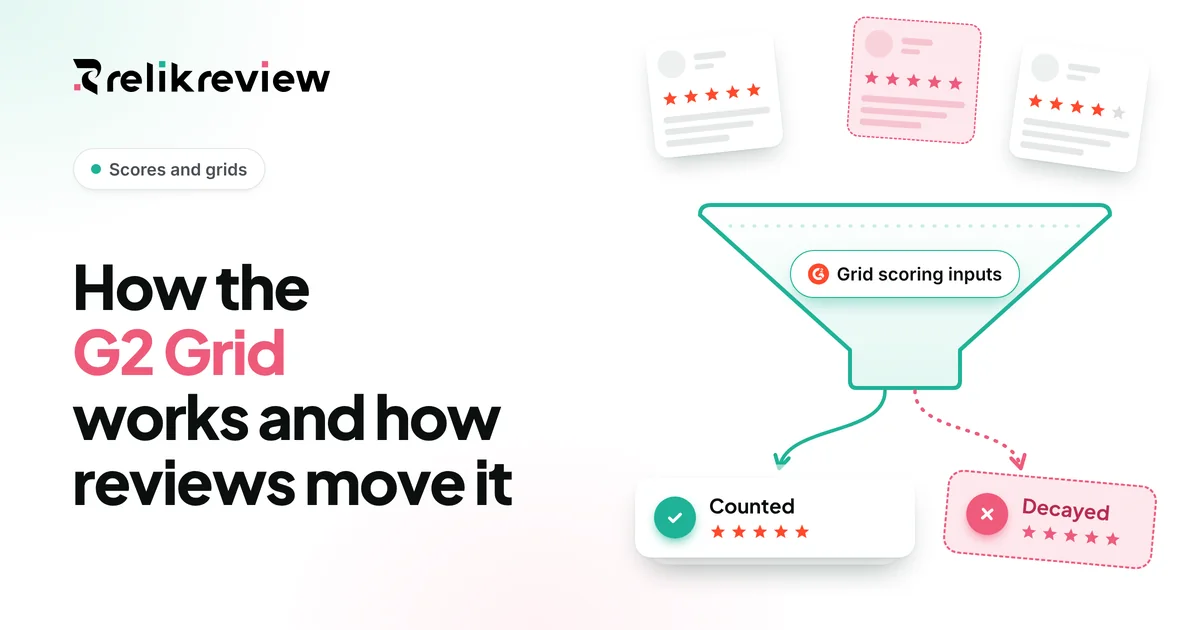
The segment and regional Grids explain why a product can rank differently across reports in the same season. Our guide to the G2 Grid explains how the satisfaction and market presence axes work and how new reviews move a product on them.
G2 report dates for Winter 2027 to Fall 2027
G2 names each season ahead of the calendar, so a season's reports arrive before the quarter they are named for. The Winter 2027 reports, for example, go live on December 1, 2026.
These are the G2 report dates published for the next four seasons, quoted exactly from the G2 Research Agenda schedule (checked October 2026):
| Season | Review deadline | Draft release | Draft edit request deadline | Final release |
|---|---|---|---|---|
| Winter 2027 | November 3, 2026 | November 11, 2026 | November 18, 2026 | December 1, 2026 |
| Spring 2027 | February 16, 2027 | February 23, 2027 | March 2, 2027 | March 16, 2027 |
| Summer 2027 | April 20, 2027 | April 27, 2027 | May 4, 2027 | May 18, 2027 |
| Fall 2027 | July 27, 2027 | August 3, 2027 | August 10, 2027 | August 24, 2027 |
The steps inside one season
Each season follows the same sequence. Using Winter 2027 as the example, G2 lists these steps:
- October 6, 2026. G2 announces the coming review deadline.
- October 26, 2026. G2 announces which reports it will publish, and it is the last day to request category changes or M&A updates.
- November 3, 2026. The review deadline.
- November 11 and 18, 2026. Drafts go to vendors to preview, then the last day to request profile updates for this season.
- November 24 and December 1, 2026. The refreshed drafts go out, then the final reports go live.

The pattern is steady across all four listed seasons. The review deadline announcement comes exactly four weeks before the review deadline, and the final release comes exactly four weeks after it, so a team that waits for the announcement to start asking has four weeks left.
How the G2 report cutoff decides which reviews count
The G2 report cutoff is the review deadline in the table above. G2 defines it as "the last day reviews can be submitted for guaranteed inclusion in that season's reports," so the date that matters is when the reviewer submits, and the page does not name a time zone. Treat the day before the deadline as your real cutoff, so a review sent late in the evening does not fall on the wrong side.
Reviews also lose weight as they age. G2's research scoring methodologies say a review decays gradually for the first 90 days and keeps a stronger weight for the first 18 months, and that after about three years it reaches approximately 3% of its original weight. Decay recalculates daily, so reviews collected in one burst two years ago count for less with every new season.

Meeting the cutoff only helps if the product qualifies. G2's methodology says a product needs at least 10 reviews in the corresponding category to appear on a Grid, and a category needs at least six products with 10 or more reviews and 150 or more reviews overall before G2 publishes a Grid report for it. Index reports add a condition: at least five responses to the report-specific questions.
Not every review counts the same way, either. G2 states that business partner reviews and guest user reviews do not affect a product's star rating or G2 Score, and that any reviews obtained by segmenting customers break its Community Guidelines and can be removed.
How to find G2 report dates for later seasons
G2 publishes its schedule a few seasons at a time, and in October 2026 its Research Agenda lists seasons up to Fall 2027. Dates for Winter 2028 and later are not on G2's pages yet, so plan only against dates G2 has published and leave later seasons open.
To find new dates, check the Research Agenda page at the start of each quarter and watch for the review deadline announcement, which comes four weeks before the deadline in every listed season. Vendors with my.G2 access can also open the Report Library, where G2 says it shows draft reports approximately two weeks before each report release.
The annual Best Software Awards follow a different rule, counting only reviews submitted in the preceding calendar year. If a date you read anywhere else differs from G2's page, go with G2's page, because it is the schedule G2 itself maintains.
How to plan reviews around G2 seasonal reports
Working back from the cutoff tells you how many reviews you need and when, which is how we plan G2 campaigns. Start with the review deadline for the season you care about, count the reviews your product already has in its category, and compare that number with the 10-review minimum and with the products closest to you on the Grid.
- Pick the season. For example, the Spring 2027 review deadline is February 16, 2027.
- Set your own cutoff a week early. That leaves room for reviewers who open the form and finish it a few days later.
- Use fixed request points. Ask every customer at points they all reach, such as day 30, day 90 or the account anniversary.
- Spread requests across the quarter. A steady flow reaches the deadline without a spike in the last week.
- Check the draft. Review the draft release and send any profile edits before the draft edit request deadline.
The aim is a steady pace that crosses the deadline with room to spare. Because a review keeps a stronger weight for its first 18 months, reviews collected evenly through the year help in every season they fall into, while a burst squeezed into the final week puts pressure on customers for little extra gain.
Plan the pace before the deadline.
The free review velocity planner shows how many reviews a month it takes to reach a target by a set date.
What G2's rules mean for review timing
A deadline is a reason to ask earlier, and it never justifies asking selectively. G2's Community Guidelines for vendors ban "collecting reviews by any method that segments out potentially negative reviews," and G2 removes the reviews when it finds evidence that a seller solicited only positive ones.
Incentives are allowed only within limits. Any incentive must be disclosed to G2, it cannot depend on the review being positive, and G2 caps its value at $100 USD across cash, gift cards and items such as swag, credits and subscriptions. G2 labels these reviews as incentivized on the profile.

The penalties reach the reports directly. For vendors who break the rules, G2 can block new reviews, revoke my.G2 access, ban the product, or remove existing reviews and report inclusions. Missing a season costs one quarter, while a removed report inclusion can cost far more, and our guide to G2 review guidelines covers how G2 checks each review before it goes live.
Want the timing handled for you?
See how our review campaigns work, from the written plan to the last review, all inside G2's rules.
 G2 review service
Get ready for the next G2 season with RelikReview
RelikReview plans G2 review campaigns backwards from the next review deadline, with verified users writing in their own words and choosing their own rating.
- Paced to the cutoffReviews arrive steadily before each deadline.
- Inside G2's rulesReviewers are never paid or asked for a rating.
- Plan in writingYou see the timing and price before anything starts.
Planning each G2 report season
G2 seasonal reports follow a fixed rhythm: four seasons a year, a review deadline four weeks before each final release, and dates that G2 publishes on its Research Agenda. Once you know the next deadline, the rest of the plan is simple arithmetic: how many reviews you have, how many you need and how many weeks are left.
Ask every customer at the same fixed points, keep the pace steady, and check G2's page each quarter for new dates. To see which badges each report can lead to, read our guide to G2 badges. If you would rather plan the timing with a team that does it every day, the RelikReview team can help you buy reviews for your business from verified users within G2's rules, starting with a look at your next deadline.
FAQs about G2 report seasons
When is the next G2 review deadline?
The next G2 review deadline on G2's Research Agenda, checked October 2026, is November 3, 2026, for the Winter 2027 reports. After that come February 16, 2027 for Spring, April 20, 2027 for Summer and July 27, 2027 for Fall 2027. Always check G2's page before planning, because it holds the official schedule.
Do reviews submitted after the deadline still count?
Reviews submitted after the deadline still count on the G2 profile and in later seasons, but G2 only guarantees inclusion in a season's reports for reviews submitted by that season's deadline. A review submitted the day after the Winter 2027 deadline should be planned for the Spring 2027 reports instead.
How many reviews does a product need to appear on a G2 Grid?
A product needs at least 10 reviews in the corresponding category to appear on a G2 Grid report. The category also needs at least six products with 10 or more reviews and 150 or more reviews overall before G2 publishes a Grid for it. Index reports also need responses to their own review questions.
Can you offer incentives for G2 reviews?
Yes, G2 allows incentives for reviews within its Community Guidelines. Every incentive must be disclosed to G2, it cannot depend on the review being positive, and its value is capped at $100 USD. G2 labels incentivized reviews, and undisclosed or conditional incentives can lead to removed reviews and lost report inclusions.