

 Addison Wilson

How reviews in AI search shape software answers
AI tools such as ChatGPT search and Google AI Overviews build many of their answers from web pages, and review sites are among the pages these answers can cite. So when a buyer asks which product to choose, what users wrote on G2, Trustpilot or Capterra can shape the summary that buyer reads first.
Review sites have started to report the effect themselves. Trustpilot's FY2025 full-year results, published on 17 March 2026, say Trustpilot ranked as the 5th most cited domain globally on ChatGPT in January 2026, according to Promptwatch. The same results report click-throughs from AI search up 1490% year on year.
What nobody outside these companies can tell you is exactly how an AI tool chooses one source over another. OpenAI and Google describe how their search features find and show sources, which we cover below, but they do not offer a recipe for being named in an answer. Treat any promise of a guaranteed place in AI answers with the same suspicion you would give a promised star rating.
How buyers use AI to research software
AI chatbots have become a normal step in software research in a little over a year. G2's Answer Economy research, published on 15 April 2026 from a survey of 1,076 B2B software buyers, found that 51% now start their research with an AI chatbot more often than with Google, up from 29% in G2's 2025 Buyer Behavior Report. It also found that 71% rely on AI chatbots at some point in their research.

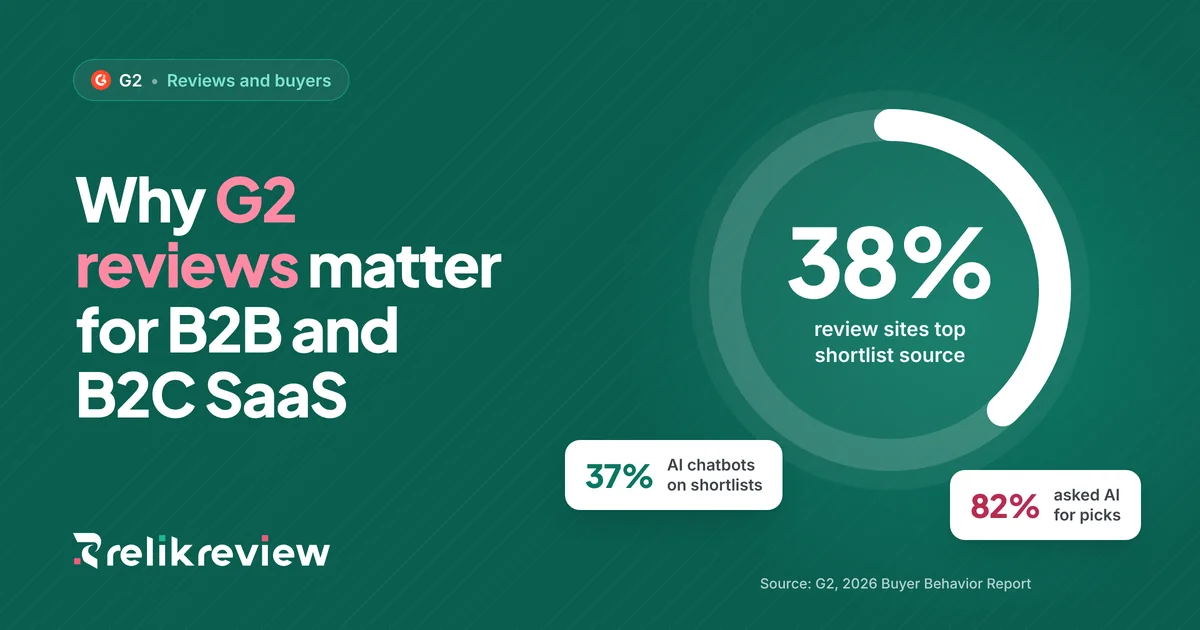
G2's 2026 Buyer Behavior Report, released on 22 July 2026, points the same way: 82% of buyers sourced software recommendations from an AI chatbot in the last 24 months. Half of those buyers said AI had the greatest impact when narrowing and comparing options, the same stage where buyers have long turned to reviews.
Being named in an AI answer also carries weight with buyers. G2's April research found that 85% of buyers think more highly of a vendor when AI includes it in an answer, and 69% chose a different vendor than they first planned simply because it was part of the chatbot's recommendation.
Why buyers still check AI answers against reviews
AI tools help build the shortlist, but buyers rarely take the answer on trust. The TrustRadius 2026 B2B Buying Disconnect report, based on 1,862 technology buyers surveyed in January 2026, found that 63% of buyers used AI during their purchase journey and 94% of those said they fact-check its responses at least some of the time. The same report found that 74% of buyers use reviews to inform their purchase decisions.
Review sites are where much of that checking happens. In G2's July 2026 report, review sites (38%) rose to be the top source shaping which vendors make a buyer's shortlist, passing AI chatbots (37%) for the first time. G2's April research also asked buyers what most increases their confidence in an AI chatbot's answer, and citations from a software review site stood out as the top trust signal.

This makes a thin or outdated review profile a double problem. It gives AI tools little to summarize about your product, and it gives the buyer who clicks through to check very little reason to believe what they read.
That is why many SaaS teams now treat review profiles as part of their search work. Teams that sell to businesses usually start with G2, and if you are asking can you buy G2 reviews that stay within G2's rules, our G2 page explains a campaign with verified users who choose their own rating. Consumer-facing products can buy real Trustpilot reviews from verified users in the same way, developer tools often add SourceForge software reviews, and our buy review service page compares every platform we cover.
How ChatGPT recommends software
How ChatGPT recommends software depends partly on whether it searches the web for the answer. OpenAI's help page on ChatGPT search says ChatGPT will automatically search the web if a question might benefit from information on the web, and that responses using search contain inline citations. A Sources button at the end of the response lists the cited sources and other relevant links.
OpenAI also says ChatGPT may share disassociated search queries with third-party search providers such as Bing. In practice, a question like "best help desk software for a 20-person team" can pull in comparison pages, vendor sites and review profiles, and the buyer can open each cited page to check it.
OpenAI's help page does not explain how ChatGPT weighs one source against another, so there is no setting or tag that makes a product appear. What a SaaS team controls is the material on the open web: its own site, its review profiles and what customers say there. G2's research adds a useful test, because buyers gain confidence when ChatGPT, Gemini and Claude describe a vendor the same way, and they treat inconsistency as a red flag.
AI Overviews, reviews and what Google says about sources
Google has published more detail. Google's guide to AI features and your website, last updated on 10 December 2025, says both AI Overviews and AI Mode may use a "query fan-out" technique, issuing multiple related searches across subtopics and data sources to develop a response. Both features then show supporting links to pages on the web.
To be eligible as a supporting link, Google says a page must be indexed and eligible to be shown in Google Search with a snippet. It adds that there are no additional requirements or special optimizations needed to appear in AI Overviews or AI Mode, and that AI Overviews only appear when Google's systems decide they add something to classic Search.
For a review profile, the meaning is simple. A public G2 or Trustpilot page is a web page like any other, so it can be eligible as a supporting link, and whether it is shown for a given search is Google's choice. Our article on do reviews help SEO covers how reviews relate to classic rankings, which is a separate question.
Why recency and detail matter for reviews in AI search
Recent, detailed reviews help in two ways: they give a buyer something concrete to check, and they give any tool that summarizes reviews more to work with. A review from three years ago describes a product that may have changed since, and a one-line review saying "great tool" tells nobody what the product actually does.
G2's April 2026 research reports that the marketers it interviewed are prioritizing review recency and volume, and coaching customers to write more frequent, context-rich reviews that speak to specific problems solved and alternatives considered. G2 also quotes Kevin Indig, whose research found that bottom-of-funnel AI answers are built on reviews. These are findings from a review site rather than statements from the makers of ChatGPT or Gemini, but they match what buyers say they check.

You cannot tell a customer what to write, and you should never ask for a particular rating. You can make a useful review easier to write by explaining in the request what other buyers want to know: the job the product does, the team that uses it, what it replaced and what could be better. Our guide on why G2 reviews matter explains how this detail helps buyers on G2 as well.
LLM brand visibility: steps for a SaaS team
LLM brand visibility is how often AI tools mention your product when buyers ask about your category, and how accurately they describe it. Nobody can promise a place in those answers, but a SaaS team can make sure the facts about its product are clear, current and consistent wherever an AI tool or a buyer might look:
- Check what AI tools say today. Ask ChatGPT, Gemini, Perplexity and Google's AI Mode the questions your buyers ask, and note which sources they cite. G2 reports that the most proactive marketers do this regularly.
- Keep your profiles complete. Keep pricing, features, categories and screenshots current on the software review sites your buyers use, so a summary built from them is accurate.
- Ask every customer at fixed points. Send the same neutral request at day 30, day 90 or the account anniversary, so happy and unhappy customers are asked alike.
- Reply to reviews. Short, calm replies to positive and negative reviews show buyers who click through that someone is listening.
- Keep your own site indexable. Google's rule for supporting links applies to your pages too, so key facts should sit in crawlable text on indexed pages.
- Stay inside the rules. Fake or gated reviews break review site rules and the law, and removed reviews leave a profile thinner than before.

Run these steps as a monthly routine and compare the AI answers from one month to the next. Changes are slow, because AI tools draw on the whole web, but a profile that grows steadily with recent, honest reviews gives both the tools and the buyers better material.
Want reviews that hold up when buyers check them?
Our RelikReview review policy explains how every campaign follows each platform's rules.
Grow your review profiles with RelikReview
RelikReview runs review campaigns on G2, Trustpilot, Capterra, SourceForge, SoftwareSuggest and HubSpot. Our RelikReview review services page shows how each campaign works, and you get the plan and price in writing first.
- Steady pacingNew reviews arrive every month, with no sudden spikes.
- Honest reviewersReviewers are never paid and choose their own rating.
- Every platform's rulesNo gating, and no rewards tied to ratings.
Making reviews work for AI answers and buyers
Reviews in AI search matter because buyers now meet your product inside an AI answer before they reach your website, and then check that answer against review sites. Google says its AI features need no special optimization, so the work that lasts is the work that has always built trust: honest reviews, collected steadily, on the sites your buyers use.
Start by asking ChatGPT and Google about your category this week and noting what they cite. If your review profiles look thin or dated, the RelikReview team can plan a steady campaign with you.
FAQs about reviews and AI answers
Does ChatGPT use reviews when it recommends software?
Yes, ChatGPT can draw on reviews when it recommends software, because answers that use web search cite the pages they draw on, and review sites are among them. Trustpilot's FY2025 results say it was the 5th most cited domain globally on ChatGPT in January 2026, according to Promptwatch. OpenAI's help page does not say how sources are weighted.
Do Google AI Overviews show reviews?
Google AI Overviews can show review pages as supporting links. Google says a supporting page must be indexed and eligible to appear in Search with a snippet, and that no special optimization is needed. A public review profile can meet that bar like any other page, but Google decides which links appear for each search.
What is LLM brand visibility?
LLM brand visibility is how often and how accurately AI tools such as ChatGPT, Gemini and Perplexity mention your product when buyers ask about your category. A SaaS team can track it by asking those tools buyer questions each month, noting the sources they cite and keeping the pages and review profiles behind those answers current.
Do buyers trust AI answers about software?
No, most buyers check AI answers about software before they rely on them. TrustRadius found in 2026 that 94% of buyers who used AI fact-check its responses at least some of the time. G2's July 2026 report found review sites (38%) narrowly ahead of AI chatbots (37%) as the top source shaping buyer shortlists.
How can a SaaS company improve its reviews in AI search?
A SaaS company can improve how its reviews show up in AI answers by keeping review profiles complete and collecting recent, detailed reviews at fixed points every customer reaches, such as day 30 or the account anniversary. It should also check AI answers each month, reply to reviews and never use fake or gated reviews.